Yesterday’s Bank Rate increase should prompt housing associations and local authorities to look beyond the cost of borrowing. The more immediate question may be what renewed inflationary pressure means for the financial resilience of the households on which rental income depends.
On 5 November, the Bank of England increased Bank Rate by 0.25 percentage points, from 3.75% to 4%, with eight of the nine members of the Monetary Policy Committee voting for the increase. [bankofengland.co.uk]
For the UK social housing sector, it would be tempting to focus on what that means for borrowing, refinancing and investment.
Those issues matter. But there is another consequence housing leaders should consider.
What happens to residents’ ability to prioritise and make essential payments when financial headroom is squeezed again?
Why did the Bank of England raise interest rates?
The Bank of England’s decision followed renewed inflationary pressure.
UK CPI inflation reached 3.5% in September, and the Bank now expects inflation to increase to around 5% by the middle of 2027. It identifies elevated global energy prices as a significant driver, with higher costs feeding directly into household utility bills and motor fuel prices.
The Bank has been careful about what happens next. Monetary policy is not on a pre-set path, and future decisions will depend on how energy costs feed through into other prices, wages and the wider economy.
That distinction matters.
A 4% Bank Rate does not mean that social rents suddenly increase by the same amount. Many social housing residents do not have mortgages.
The transmission mechanism is more complex.
Bank Rate influences borrowing costs across the economy, while the inflation that prompted the increase is simultaneously putting pressure on household essentials.
For households managing on limited disposable income, the result can be less financial flexibility.
And when household headroom falls, the issue changes from simply“Can I pay?” to“What do I pay first?”
Why payment resilience matters for housing associations and local authorities
This distinction is particularly important because the social housing sector enters this period from a stronger arrears position than headlines about household pressures might suggest.
Housemark data reported by Housing Executive, covering 161 UK social landlords, showed median current-tenant arrears at 2.47% at the end of 2025/26, compared with 2.81% in March 2022. Some 57% of participating landlords had reduced arrears over the previous year. [housingexe…tive.co.uk]
That is evidence of considerable progress.
It is also why it would be wrong to suggest that yesterday’s interest-rate increase means an arrears crisis is inevitable.
It does not.
The more useful question is how housing providers can protect those gains if household finances come under renewed pressure.
That becomes more significant when viewed alongside allpay’s research into social renters’ payment behaviour.
Our latest research found that only 43% of surveyed social renters regarded rent as their number-one priority when paying bills, down from 62% in 2022.
That does not mean residents do not want to pay their rent.
It demonstrates how intense the competition between essential household commitments can become.
When energy, food, transport, credit and other essential expenditure compete for a finite household budget, payment behaviour can change before a resident ever formally enters arrears.
That makes payment resilience a preventative issue, not simply a collections issue.
The answer cannot simply be to “collect harder”
This is where yesterday’s Bank Rate decision becomes relevant to payment strategy.
Housing associations and local authorities cannot control interest rates. They cannot control wholesale energy markets. And they cannot remove every financial pressure facing residents.
They can, however, influence how easy it is for someone to make a payment when money is available.
That means avoiding the assumption that one payment method, frequency or customer journey works for everybody.
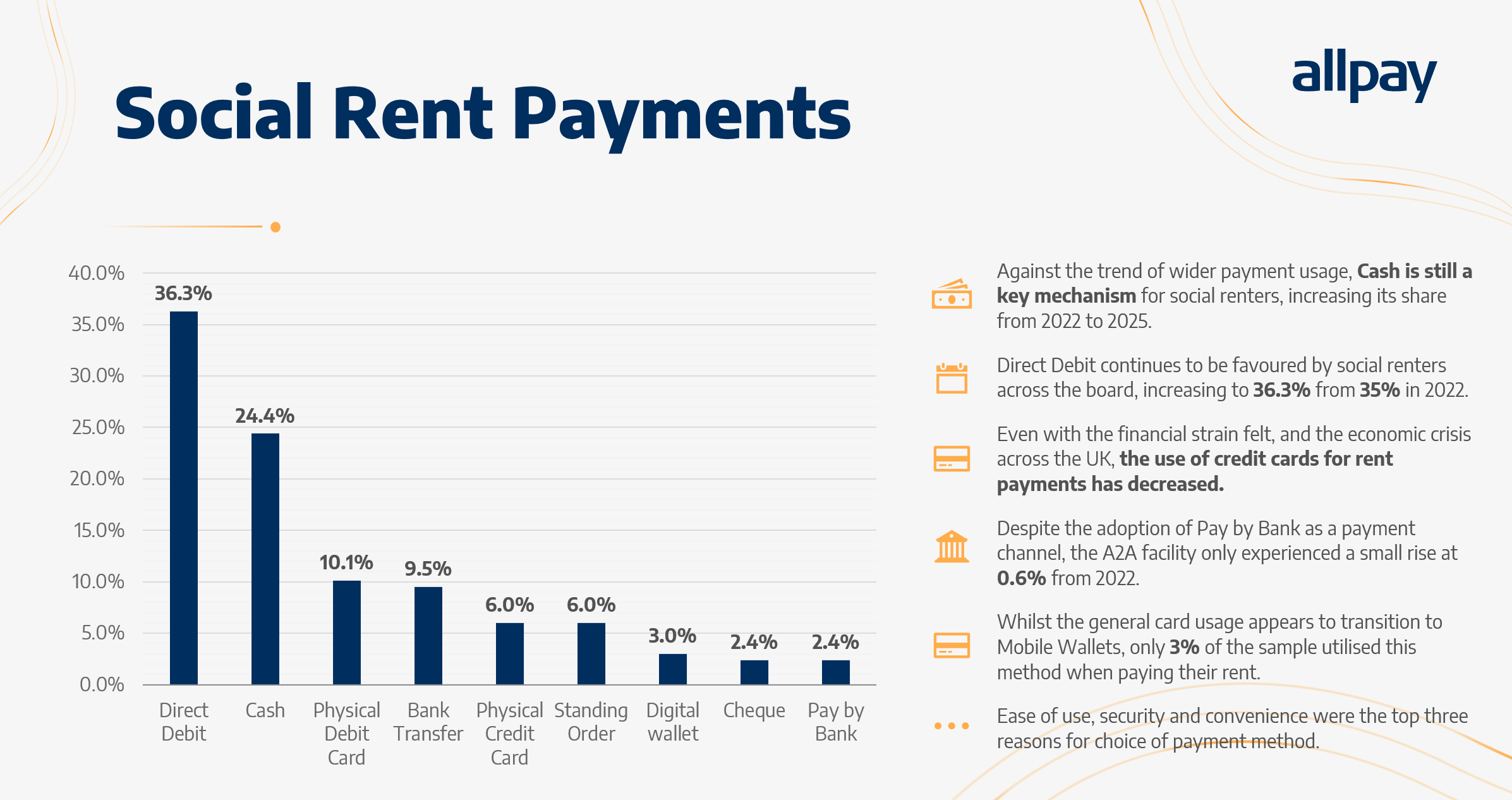
allpay’s The UK Payments Landscape research shows the diversity clearly. Among surveyed social renters, Direct Debit accounted for 36.3% of rent payments, cash for 24.4%, physical debit cards for 10.1% and bank transfers for 9.5%. Digital wallets and Pay by Bank accounted for 3% and 2.4% respectively.
The lesson is not that one of those methods will “win”.
It is that resilience depends on appropriate choice.
Direct Debit may work extremely well for a resident with predictable income and expenditure. Another resident may prefer a manual or cash-based payment because it gives them greater control over when money leaves their budget. Others may increasingly choose account-to-account or digital journeys.
Removing payment friction therefore means meeting residents where they are, rather than designing collections solely around the channel an organisation would prefer them to use.
Cash and financial inclusion still matter
Digital transformation remains crucial to public-sector efficiency.
But digitisation and inclusion are not synonymous.
allpay’s research found that 15% of social renters surveyed did not have a current account, compared with 13% across the overall research sample.
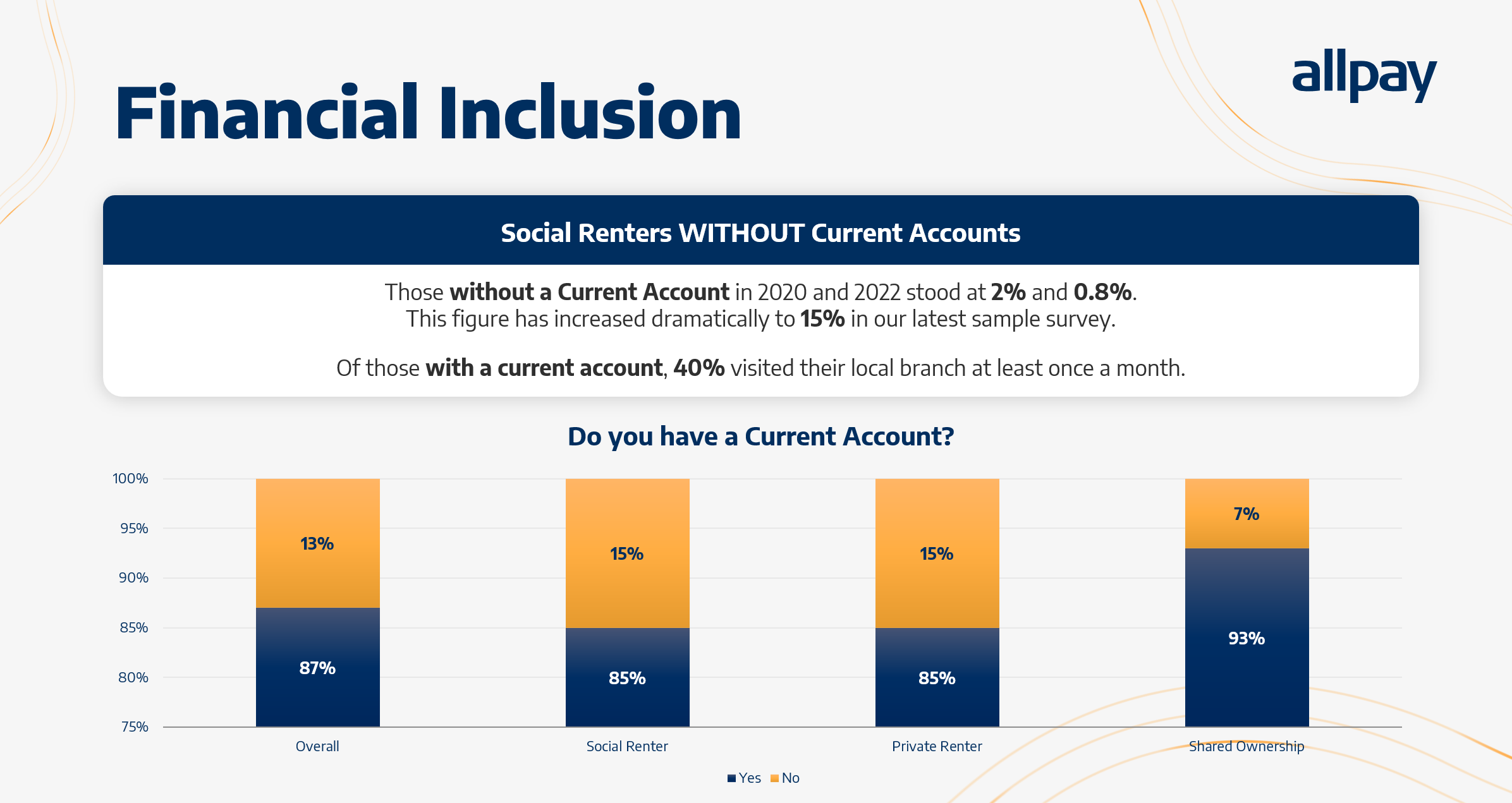
The same research found cash remains an important payment mechanism for social renters and is used for around 24% of rent payments in the surveyed group.
That matters strategically.
If financial pressure increases while payment strategies simultaneously become less accessible to people who rely on cash, manual payments or human support, providers risk introducing friction at exactly the point they are trying to protect income.
Payment accessibility should therefore be considered part of income protection, not simply customer service.
Payment timing matters as much as payment type
There is another useful signal in residents’ behaviour.
allpay’s research found 67% of surveyed social renters paid rent monthly, up from 49% in 2022.
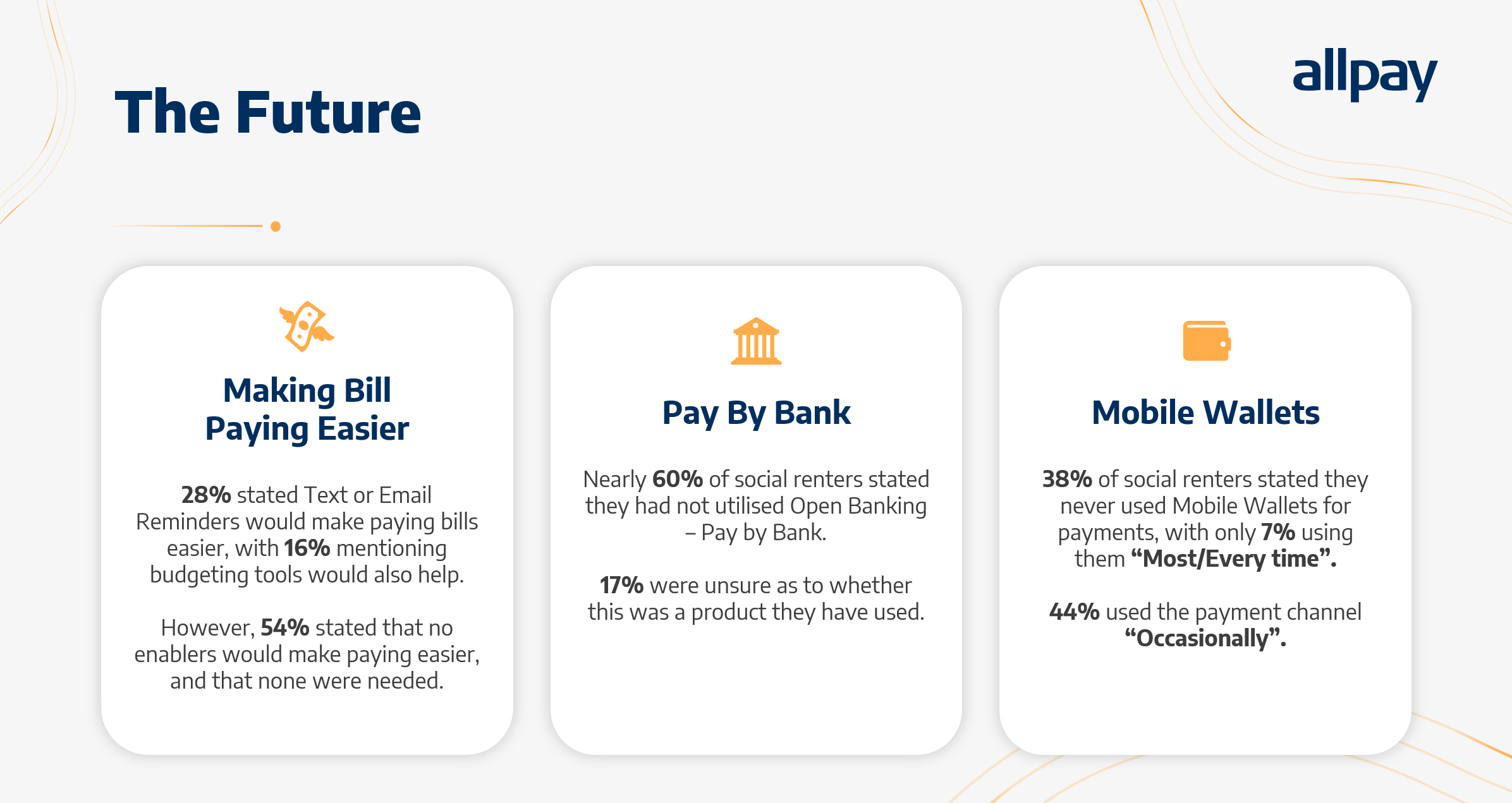
At the same time, 28% said text or email reminders would make paying bills easier, while 16% identified budgeting tools.
For housing providers, this points towards a broader conception of payment strategy.
It is not simply which channel a resident uses.
It is whether payment journeys fit the way residents receive, manage and allocate money.
Practical interventions can therefore include:
- maintaining an appropriate mix of Direct Debit, debit card, digital, account-to-account and cash-supported payment options;
- providing timely payment reminders before a commitment becomes overdue;
- ensuring payment journeys are simple enough to complete when funds are available;
- monitoring changes in payment behaviour that may indicate financial pressure;
- retaining access to human support for residents who need it; and
- using innovation to extend choice rather than inadvertently remove it.
The strategic objective should be simple: make the successful payment the easiest outcome possible.
From arrears management to early intervention
For housing providers, an arrears balance is a lagging indicator. By the time it appears, a resident may already have spent weeks or months making difficult trade-offs.
A stronger approach is therefore to look for earlier signals.
A normally consistent payer beginning to make payments later, switching payment methods, making smaller or more irregular payments, or repeatedly abandoning payment journeys can all be reasons to examine whether support or a different journey might help.
The opportunity is not to use data to label residents as “risky”.
It is to use payment intelligence to recognise changing behaviour sooner and make the appropriate intervention easier.
That distinction will become increasingly important if the inflation outlook develops as the Bank of England currently expects.
What should housing leaders do now?
Yesterday’s rate increase is not evidence, by itself, that social-housing arrears are about to rise.
Indeed, the latest Housemark figures demonstrate that landlords have achieved significant improvements in arrears performance despite sustained cost-of-living pressures. [housingexe…tive.co.uk]
But protecting that performance in a renewed inflationary environment requires more than an efficient collections process.
For housing associations and local authorities, four questions deserve attention:
- 1. Are residents offered genuine payment choice?
A digital-first strategy should not become a digital-only strategy where that creates exclusion.
- 2. Where does friction exist in the payment journey?
Every unnecessary login, failed hand-off, inconvenient channel or poorly timed communication creates another opportunity for an intended payment not to happen.
- 3. Can changing behaviour be recognised before arrears build?
Payment patterns can provide useful operational signals, provided they are used responsibly and alongside appropriate resident support.
- 4. Does payment strategy connect inclusion with income protection?
Payment accessibility, financial inclusion and collection performance should not be treated as separate objectives. Increasingly, they are different aspects of the same challenge.
The bigger lesson from a 4% Bank Rate
The significance of the Bank of England’s decision extends beyond the headline rate.
The Bank is signalling that inflationary pressure has strengthened sufficiently to require tighter monetary policy, with household energy and fuel costs central to its outlook. [bankofengland.co.uk].
For social housing providers, that should focus attention on something they can influence.
Not Bank Rate.
Not global energy prices.
But the resilience of the payment relationship between resident and landlord.
The organisations best placed to protect income will not necessarily be those that collect hardest once arrears appear. They will be those that spot changing behaviour early, remove unnecessary payment friction and give residents realistic, accessible ways to meet essential commitments.
For housing leaders, the strategic question is therefore no longer simply what higher interest rates mean for the organisation’s own cost of capital.
It is what sustained financial pressure could mean for the resilience of the households on which its income ultimately depends.